
At Esasem, research is the beating heart of our work. Since 1988, we have continuously invested in innovation and development to offer high-quality vegetable seeds that meet the needs of an ever-evolving market.
Our research facilities focus on major horticultural species, including tomato, pepper, watermelon, zucchini, broccoli, cauliflower, and melon. We employ both conventional breeding techniques and advanced molecular biology applications to develop varieties with strong genetic resistance to diseases such as fusarium wilt, bacterial infections, viral diseases, and cyst nematode attacks.
Special attention is dedicated to resistance to TSWV (Tomato Spotted Wilt Virus), which is widespread in Mediterranean growing areas.
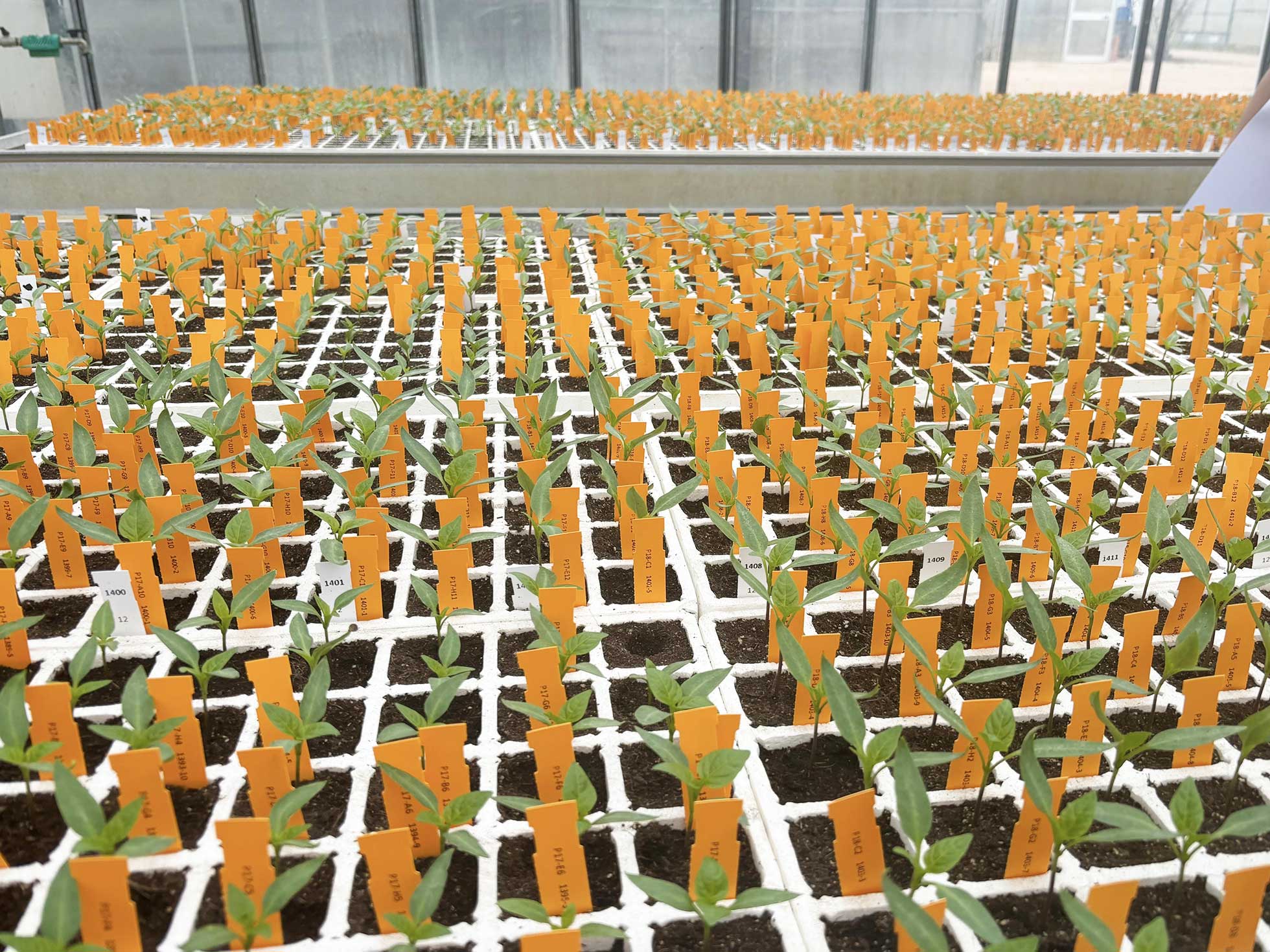
Our commitment to research enables us to offer varieties with superior characteristics in terms of productivity, quality, and environmental adaptability, thus ensuring the sustainability of horticultural enterprises and contributing to the success of our customers.
As for the INDUSTRIAL TOMATO, the objectives of its “breeding” are increasingly focused on the qualitative aspects that characterize the product delivered to the factory, as well as on environmental adaptability and bioresistance.
With the application of conventional selective techniques, but also making extensive use of molecular biology, genes for resistance to plant diseases such as tracheomycosis, bacteriosis, virosis and those resulting from attacks by cystic nematodes are associated in the lines in stabilization. These diseases are increasingly widespread where cultivation is carried out intensively, with short rotation shifts and following the excessive proliferation of so-called “vector” insects.
To prevent viral infections and as the chemical fight against insects is not always decisive, the use of genetically induced resistance therefore appears to be the most effective, as well as the most ecological, means. Still with regard to pathogenic viruses, the one currently most feared and widespread in the main cultivation areas of the Mediterranean is the TSWV or spotted wilt virus, whose generation inside the tomato plant is favored by the lesions practiced by a tyramopteran insect called thrips . All the main F.1 hybrids of processing tomatoes proposed by ESASEM in risk areas are resistant or highly tolerant towards this virus, being provided with a dominant gene, with a broad spectrum of action, signed as SW-5.
There are numerous types of FRESH CONSUMPTION TOMATOES that the research deals with, starting from salad food” of large size and for single fruit harvesting, up to the “cherry and datterino”, to be harvested in whole bunches, with “mignon” fruits with a crunchy and tasty pulp. Contrary to the industrial tomato, which shows a limited typological differentiation, but which is strongly characterized by the technological requisites it must possess in relation to the type of industrial transformation for which it is intended, the so-called table tomato, has very logical characteristics and much more variable production attitudes, in relation to the demands of the consumer markets, seasonality and the cultivation environment (think of the greenhouse).
ESASEM “Breeders” conduct intense research programs to build well-characterized F.1 hybrids, then having them pass through severe selective tests conducted at the company headquarters, but also in the most typical cultivation areas, in Italy and abroad.
Even the fresh market tomato must be protected against disease. The “greenhouse” environment favors the proliferation of parasitic insects and the development of dangerous masses of inoculum, fungal, bacterial and viral. ESASEM researchers work to associate the genotypes in the selection phase with genes for resistance against tracheomycosis and Fusarium roots lycopersici in particular, cladosporiosis, nematodes and some of the most harmful viruses, such as ToMV, TYLCV and TSWV, a virus which is also widespread in the open field on processing tomatoes.
Thanks also to the collaboration with leading Italian and foreign university institutes, the onset of diseases is monitored with phytopathological techniques such as the DAS-ELISA; the resistance genes are prepared and then inserted into the “inbred” lines with crossing, back-crossing and individual selection, the acquired resistance is finally confirmed with the use of innovative molecular methodologies and with the use of markers molecular.
The PEPERONE is a species widely cultivated in various parts of Italy. ESASEM has a wide commercial range of interesting hybrids, destined for the domestic and foreign markets, especially in Spain, Portugal, Greece, Eastern Europe and Turkey.
The types offered are different, both in relation to the cultivation environment for which they are intended, the open field or the greenhouse, and in terms of the shape and color of the berry. The genetic improvement practiced at the Italian headquarters and in Hungary, at the associated Budakert, has the objective of promoting optimal plant development, fruit uniformity and a broad spectrum of resistance to the most dangerous diseases to be achieved with use of advanced techniques.
ESASEM geneticists have thus managed to include, in the “gene pool” of various F.1 pepper hybrids, resistance against viruses such as TMV (L3,L4) and TSWV, but also resistance against bacteriosis ( BS) and nematodes (N).
The MELON is a cucurbit whose consumption is widespread all over the world, but which takes on a “gourmet” value in some countries in particular, including Italy. The intense flavor, the fragrant pulp and the combination with savory foods (think of ham and melon), represent a culinary delicacy appreciated by many.
The ESASEM “Breeders” are working to expand the range and obtain competitive F.1 hybrids in the various types of cucumis melo, with yellow flesh and netted or smooth rind and in that of cucumis inodorus with white flesh, widespread above all in southern Europe and in Middle East. The genetic improvement of these species concerns the productivity, the resistance to overripening (the “long shelf life” character), the resistance to cracking and to the most common diseases, such as fusariosis (FOM) and white mallow (PM).
WATERMELON, which like melon belongs to the Cucurbitaceae family, is a popular vegetable whose maximum consumption is in the summer, especially when it is very hot. The juicy pulp of the fruit, in addition to providing mineral salts, vitamins and fiber, is in fact very thirst-quenching, while promoting diuresis.
The “Breeding” activities are therefore aimed at improving the organoleptic characteristics of the pulp and also at conferring resistance to FOM and anthracnose. The most successful ESASEM F.1 hybrids are placed in the “Crimson” typology, with round, oval and elongated shapes.